
Imagine waking up, grabbing your morning coffee, and finding new leads waiting in your inbox. This isn’t just a dream; it’s a reality for businesses that utilize automated systems. At IBP (The Internet Business Provider), we specialize in turning ordinary websites into powerful lead capture machines.
While your competitors may only operate during business hours, your potential customers are active around the clock. They are browsing, researching, and looking for solutions at all hours. If your website isn’t equipped to engage them, you risk losing valuable opportunities.
Our team focuses on creating automated systems that work tirelessly, ensuring you never miss a chance to connect with high-intent prospects. From customized lead funnels to AI chatbots, we provide the tools you need to transform your online presence into a relentless lead generation engine.
In this article, we will guide you through the steps to build your own automated lead capture system. By the end, you’ll understand how to turn your website into a 24/7 lead generation powerhouse.
Key Takeaways
- Learn how an automated system can continuously capture leads.
- Understand the importance of being available when potential customers are online.
- Discover tools that can help engage and qualify leads.
- See real-world examples of successful automated lead generation.
- Get step-by-step guidance on implementing your own system.
The User Intent Behind a 24/7 Sales Engine
Picture your website acting as a 24/7 sales representative, ready to assist visitors whenever they arrive. This model uses AI and automation to ensure that potential customers receive immediate responses to their inquiries. In today’s fast-paced world, people often search for solutions outside of traditional business hours.
The modern buyer’s journey has transformed. Prospects now conduct research late at night or early in the morning. They expect to find answers and guidance whenever they choose to browse. This shift in behavior means that businesses must adapt their strategies to capture leads effectively.
The core user intent behind searches related to a 24/7 sales model is to find reliable, automated solutions. Many business owners and marketers are looking for ways to engage visitors without needing constant human availability. They understand the pain of missed opportunities when a high-intent visitor leaves without interaction.
Users searching for this topic are often seeking practical strategies rather than theoretical concepts. They want to know how AI and automation can replicate the responsiveness of a live sales representative. Maintaining a personal touch and building trust through automated interactions is crucial for these users.
By aligning the content of this article with the reader’s desire to stop losing leads, we aim to help businesses build a predictable, round-the-clock sales pipeline.
| User Intent | Description |
|---|---|
| Immediate Engagement | Providing instant responses to customer inquiries. |
| Lead Capture | Strategies to secure leads outside of business hours. |
| Automation | Utilizing AI to engage visitors without human intervention. |
| Trust Building | Maintaining a personal touch in automated interactions. |
What Is a 24/7 Sales Engine?
Imagine a sophisticated setup that transforms your website into a dynamic sales platform. A 24/7 sales engine is an interconnected network of automated tools. This includes interactive chatbots, dynamic landing pages, and automated lead capture systems. Together, they create a seamless, always-on lead generation and qualification process.
Unlike a traditional marketing funnel, which often stops at conversion, a sales engine extends through to revenue generation. It utilizes automated, predictable processes that keep your business thriving. The goal is to ensure that no lead goes cold while maximizing the efficiency of your existing traffic.
Automated Chatbots and AI Interaction
Automated chatbots serve as the frontline of this engine. They engage visitors instantly, providing contextual conversations that answer product questions. These bots can also qualify leads based on predefined criteria, ensuring that your team focuses on the most promising prospects.
Dynamic Landing Pages and Lead Capture
Dynamic landing pages are crucial for maximizing conversion rates. They adapt to visitor behavior and traffic sources, presenting the most relevant offers and messaging. This personalization increases the likelihood of capturing leads effectively.
CRM Integration and Lead Management
CRM integration acts as the backbone of your sales engine. It ensures that every captured lead is automatically routed and assigned. This process allows leads to be enrolled in appropriate nurturing sequences without manual intervention. The synergy between these components creates a system that is greater than the sum of its parts.
In summary, a 24/7 sales engine is not about replacing human salespeople. Instead, it augments their capabilities by handling initial engagement and qualification automatically. By implementing such a system, businesses can provide immediate responses to prospects at any hour, building trust and capturing interest that would otherwise be lost to competitors.
Why Your Business Needs a 24/7 Sales Engine
Even after hours, your target audience is actively seeking answers to their problems. While your competitors are working an 8-hour day, your ideal clients are browsing, researching, and looking for solutions around the clock. If your digital storefront goes dark when you log off, you are leaving revenue on the table.
Imagine this scenario: It’s 10 PM. A perfect-fit prospect lands on your website, ready to talk. But your sales team clocked out hours ago. By the time they’re back online, that prospect’s interest has gone cold, and they’re already talking to your competitor. Poof. A deal disappears before you even knew it existed.
The goal isn’t to make your team work around the clock. It’s about using smart AI to build an always-on system that can engage, qualify, and capture leads, even while you sleep.
- There is a fundamental mismatch between traditional business hours and modern consumer behavior.
- A significant percentage of website traffic and purchase decisions occur outside standard 9-to-5 hours, creating a substantial opportunity gap.
- Every minute a lead waits for a response decreases the probability of conversion, making instant engagement critical.
- A 24/7 sales engine eliminates the risk of hot leads going cold simply because no one was available to respond.
- This technology allows businesses to scale their sales capacity without increasing headcount, as the automated system handles initial qualification and routine inquiries.
- Competitors are already adopting these technologies, and businesses that delay risk falling behind.
- A 24/7 sales engine maximizes the return on existing marketing investments by converting more of the traffic already coming to the website.
In conclusion, the need for an always-on system is urgent and practical. Every night and weekend without this capability results in tangible revenue lost. Your business cannot afford to miss out on potential leads simply because you were offline.
Key Benefits of Implementing a 24/7 Sales Engine
Envision a scenario where your business never misses a chance to connect with interested prospects, day or night. The main upside is simple: you get more out of the traffic you already have, and no hot lead ever gets the cold shoulder. This approach frees up your actual team to focus on what humans do best: building relationships and closing deals.
Using AI to build a 24/7 sales model isn’t just a far-off idea anymore; it’s a smart way to grow your business. The right tool turns your website from a passive page into your best salesperson, one that knows everything, works all the time, and never needs a coffee break.
- Capture and Qualify Leads: An always-on system ensures that leads are captured and qualified at any hour without human intervention, making sure no opportunity is missed.
- Increase Conversion Rates: Providing immediate responses to visitor inquiries significantly boosts conversion rates, enhancing the likelihood of turning a prospect into a lead.
- Improve Customer Experience: Visitors receive instant, accurate answers to their questions, eliminating the frustration of waiting for business hours or navigating complex FAQ pages.
- Enhance Operational Efficiency: Routine inquiries and initial qualification are handled automatically, allowing sales teams to focus on high-value activities like relationship building and closing complex deals.
- Consistent Messaging: A 24/7 sales engine delivers consistent, on-brand messaging across every interaction, removing variability that can arise from different sales representatives.
- Scalability: The system can manage unlimited simultaneous conversations without a drop in quality or response time, accommodating growth effortlessly.
- Data and Insights: Each automated interaction generates valuable analytics about prospect behavior, common questions, and conversion patterns, which can inform future strategies.
These benefits compound over time as the system learns and improves, creating a sustainable competitive advantage that grows stronger with use.
How AI and Automation Power the Modern 24/7 Sales Engine
Consider how your website can function like a tireless assistant, ready to engage visitors at any hour. The integration of AI and automation into your sales strategy is essential for capturing leads and nurturing them effectively. These technologies work together to streamline processes, enhance customer interactions, and ultimately drive conversions.
AI-Driven Lead Qualification and Engagement
Artificial intelligence serves as the cognitive core of a modern sales system. It enables sophisticated lead qualification that goes beyond simple keyword matching. AI can understand intent and context, allowing for tailored interactions with visitors. For instance, AI-driven chatbots engage users in natural conversations, assessing their needs and answering product questions.
Automated Email Nurturing and Follow-up Sequences
Automation also plays a critical role in lead nurturing. Automated email sequences trigger based on specific prospect behaviors. This ensures that personalized content is delivered at optimal times, guiding leads through the sales funnel without manual intervention. Imagine a lead filling out a contact form and being automatically added to your CRM, assigned to a representative, and enrolled in a personalized email sequence—all within seconds.
Data Integration and Predictive Analytics
Data integration acts as the connective tissue that unifies information from various sources. This includes website interactions, email engagement, and CRM records. By leveraging predictive analytics, businesses can score leads and identify which prospects are most likely to convert. This allows sales teams to prioritize their efforts effectively, focusing on the most promising opportunities.
In summary, the combination of AI and automation transforms the sales process from reactive to proactive. By anticipating prospect needs before they are explicitly stated, businesses can create a seamless experience. A visitor can engage with a chatbot, receive follow-up emails, and be routed to the appropriate sales representative based on their specific needs and readiness.
| Feature | Description |
|---|---|
| AI-Driven Engagement | Chatbots interact with visitors, assessing needs and readiness. |
| Automated Email Sequences | Trigger personalized content delivery based on user behavior. |
| Predictive Analytics | Score leads and identify high-conversion prospects. |
| Data Integration | Unify information from multiple sources for comprehensive insights. |
Main Features to Look for in Your 24/7 Sales Engine
Your business’s online presence can become a powerful tool that never sleeps, ready to engage potential customers at any moment. However, not all AI tools are created equal. To cut through the marketing fluff, focus on a few things that actually matter when you’re trying to build a robust system.
First, consider how fast you can get the tool working. Look for solutions that you can set up yourself in just a few hours, rather than ones that require a lengthy project with a team of consultants.
Next, assess the intelligence of the AI. The best tools can handle tricky questions and allow you to control their personality, knowledge, and what they’re permitted to do. This level of customization ensures that your digital assistant aligns with your brand’s voice.
Another critical factor is seamless knowledge integration. An AI is ineffective if it doesn’t have access to the right information. Prioritize tools that can connect directly to your website, internal documents, and help centers for accurate answers.
Additionally, evaluate the pricing structure. Transparent and predictable pricing is essential. No one wants a surprise bill just because they had a good month in business.
- Ease of Setup: Choose tools that can be implemented quickly to avoid delays.
- AI Intelligence: Look for systems that can engage in complex conversations and provide relevant answers.
- Knowledge Integration: Ensure the AI can access and utilize information from various sources.
- Customization: Select tools that allow you to control the AI’s personality and tone.
- Transparent Pricing: Opt for clear pricing models without hidden fees.
- CRM Integration: Ensure the tool syncs lead data with your existing workflows.
- Analytics Features: Look for insights into conversation volume and lead quality.
- Mobile Responsiveness: Ensure the system works well across devices and platforms.
By focusing on these essential features, your team can effectively evaluate and implement a 24/7 sales system that enhances your business’s online capabilities.
Top AI Tools for Building a 24/7 Sales Engine in 2026
As the digital landscape evolves, the tools for capturing leads have become more sophisticated than ever. In this section, we will explore the top AI tools that can help you build a robust, always-on sales system for your business.
eesel AI: Self-Serve, Knowledge-Aware Chatbot
eesel AI is designed to be the “brain” that integrates with the tools you already use. This self-serve chatbot can be deployed in under an hour. It learns from your website, internal documents, and Shopify catalogs. The Team Plan is priced at $299/month for up to 1,000 AI interactions, while the Business Plan costs $799/month for up to 3,000 interactions.
HubSpot Sales Hub: All-in-One CRM and AI Automations
HubSpot Sales Hub offers a comprehensive CRM solution with built-in AI prospecting and automation features. This platform is ideal for teams seeking a unified system. Pricing starts at $15/seat/month for the Starter plan, with Professional and Enterprise tiers priced at $90/seat/month and $150/seat/month, respectively.
Drift: Conversational Marketing for B2B Sales
Drift, now part of Salesloft, is a leader in conversational marketing. It uses AI-powered chatbots to qualify leads and book meetings. Pricing is custom and determined after a demo, making it flexible for various business needs.
Zendesk: Enterprise-Grade Sales and Support Platform
Zendesk is a trusted, enterprise-grade platform featuring an AI-powered Answer Bot. This tool aids in lead qualification and data capture. The Suite Team plan is available for $55/agent/month, with Professional and Enterprise plans at $115/agent/month and $169/agent/month, respectively.
Gorgias: E-commerce-Focused Automated Support
Gorgias specializes in e-commerce support for platforms like Shopify, BigCommerce, and Magento. It pulls customer order information directly into chat conversations. Pricing starts at $50/month for 300 tickets, with higher tiers available for increased ticket volumes.
Freshdesk: Integrated AI Chatbots with CRM Sync
Freshdesk is part of the Freshworks ecosystem, offering a free plan for up to 10 agents. The Growth plan is priced at $15/agent/month, while the Pro and Enterprise plans are $49/agent/month and $79/agent/month, respectively. Freddy AI Copilot is an additional feature priced at $29/agent/month.
| Tool | Key Features | Pricing |
|---|---|---|
| eesel AI | Self-serve chatbot, knowledge-aware | $299/month (Team), $799/month (Business) |
| HubSpot Sales Hub | All-in-one CRM, AI prospecting | From $15/seat/month |
| Drift | Conversational marketing, lead qualification | Custom pricing |
| Zendesk | AI-powered Answer Bot, enterprise-grade | $55/agent/month (Team) |
| Gorgias | E-commerce focused, integrates with Shopify | From $50/month |
| Freshdesk | Integrated AI chatbots, CRM sync | From $15/agent/month |
Choosing the Right 24/7 Sales Engine for Your Business
Finding the perfect 24/7 sales solution requires careful consideration of your unique business needs. Start by asking yourself, “What is my main goal?” If you’re a B2B company aiming to book more demos, tools like Drift are tailored for that purpose. For e-commerce businesses seeking a mature solution, Gorgias stands out as a market leader.
Next, consider where your critical business information resides. Does it live on your website, or is it scattered across internal Google Docs and random PDFs? If your data is spread out, a complementary tool like eesel AI can connect these various sources, providing a more cohesive experience for your customers.
Another essential factor is compatibility with your existing technology stack. The last thing you want is to switch your CRM or helpdesk systems. Look for a solution that integrates seamlessly with what you already have in place.
Don’t forget to test before you commit. Many platforms, such as eesel AI, offer free trials. This allows you to evaluate how well the AI performs with your content before making any financial commitments.
Consider the pricing model as well. Transparency and predictability are crucial. Avoid solutions with usage-based fees that could lead to unexpected costs during peak sales periods.
Lastly, evaluate the level of customization available. Ensure the AI can represent your brand authentically, including personality, conversation flows, and overall branding. The right choice will balance your current needs with scalability for future growth.
In summary, selecting the right automated system involves asking the right questions and ensuring it aligns with your business strategy. A well-chosen tool can enhance your team’s efficiency and support your growth objectives.
Step-by-Step Guide to Building Your 24/7 Sales Engine
Imagine transforming your website into a powerful lead-capturing tool that operates around the clock. Building a 24/7 sales engine involves a systematic approach. Here’s a step-by-step guide to help you through the process.
- Audit Your Current Lead Capture Processes: Begin by assessing your existing methods. Identify gaps and missed opportunities. Pay attention to the specific hours when prospect engagement drops off. This will help you understand where improvements are needed.
- Select the Right AI Tools: Choose an AI tool that aligns with your business requirements. Consider the capabilities of each tool and how they match your strategy. Look for solutions that can effectively engage and qualify leads.
- Prepare Your Knowledge Base: Organize your website content, product information, FAQs, and internal documentation. Ensure this information is in a format that the AI can learn from and reference effectively. A well-prepared knowledge base is crucial for accurate responses.
- Configure Chatbot Conversation Flows: Set up your chatbot with greeting messages, qualification questions, and escalation paths. Ensure these flows align with your sales process to provide a seamless experience for users.
- Set Up Automated Email Nurturing Sequences: Create email sequences that trigger based on specific prospect actions. Deliver relevant content at strategic intervals to nurture leads effectively.
- Integrate with Your CRM: Ensure that all captured leads, conversation transcripts, and qualification data flow automatically into your existing sales workflows. This integration is essential for maintaining an organized approach to lead management.
- Test the System Thoroughly: Before launching, conduct tests using real-world scenarios. Validate the accuracy of responses and the quality of conversations. This step is vital to ensure a smooth user experience.
- Deployment Best Practices: Once everything is set, deploy your system. Monitor its performance closely. Use data and feedback to optimize and refine your sales engine over time.
By following these steps, you can build a robust system that captures leads and engages customers at any time. The result will be a powerful tool that enhances your business’s ability to connect with potential clients.
| Step | Description |
|---|---|
| 1 | Audit current lead capture processes to identify gaps. |
| 2 | Select AI tools that match your business needs. |
| 3 | Prepare a comprehensive knowledge base for the AI. |
| 4 | Configure chatbot flows to align with your sales process. |
| 5 | Set up automated email nurturing sequences for leads. |
| 6 | Integrate the system with your CRM for seamless management. |
| 7 | Test the system to ensure accuracy and quality. |
| 8 | Deploy and monitor for ongoing optimization. |
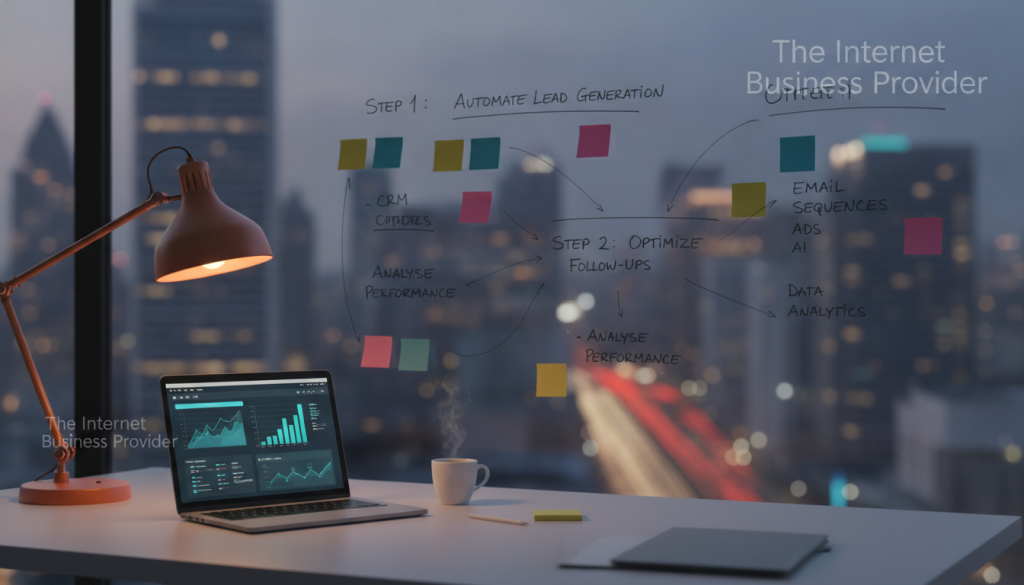
Integrating Your 24/7 Sales Engine with Existing Sales and Marketing Systems
Bridging your 24/7 sales operations with current marketing systems can significantly enhance your business’s revenue potential. A seamless integration creates a unified revenue generation ecosystem, allowing your team to work more efficiently.
Proper CRM integration ensures that every lead captured by your AI chatbot is automatically created as a contact. This contact is enriched with conversation data and assigned to the appropriate sales representative based on predefined routing rules. This process eliminates the risk of losing valuable leads due to manual entry errors.
Connecting your sales engine with email marketing platforms is equally important. This connection enables automated nurturing sequences that keep the conversation going and guide prospects through the sales funnel. By doing so, you can ensure that leads receive timely follow-ups and relevant content.
Integration with analytics and reporting tools provides a comprehensive view of the entire customer journey. From the initial website visit to the closed deal, having access to this data allows your team to make informed decisions and refine strategies over time.
However, common integration challenges can arise. Issues such as data format inconsistencies, duplicate record creation, and synchronization delays can hinder performance. Addressing these challenges with practical solutions is crucial for maintaining a smooth workflow.
API-based integrations offer a solution by allowing real-time data exchange and custom workflow automation between systems. This capability enhances the overall efficiency of your operations.
The ultimate goal of integration is to create a seamless experience. Prospects should move effortlessly from automated engagement to human interaction without losing context or having to repeat information. For example, pairing a specialized AI chatbot with an existing CRM or helpdesk platform can enhance capabilities without replacing core systems.
Optimizing Lead Capture and Nurturing with Automated Workflows
Visualize a scenario where your business captures leads effortlessly, even while you sleep. Automation takes over manual, repetitive tasks that consume valuable time. Imagine a system where a lead fills out a contact form and is automatically added to your CRM, assigned to a sales representative, and enrolled in a personalized email sequence—all within seconds. This level of efficiency not only improves your conversion rates but also frees up your team to focus on what humans do best: building meaningful relationships.
AI-powered tools can personalize lead nurturing by automatically sending targeted content to prospects based on their behavior. Here are some key strategies to optimize your lead capture and nurturing:
- Strategic Placement: Position chatbots and dynamic forms on high-intent pages to significantly increase conversion rates.
- Conversation Flow Design: Create flows that balance information gathering with user experience, avoiding overly aggressive qualification that may drive prospects away.
- Automated Workflows: Segment leads based on behavior, demographics, and engagement levels to deliver personalized nurturing sequences that resonate with each prospect’s specific needs.
- Email Nurturing Campaigns: Focus on timing, content relevance, and progressive profiling to gradually build a complete picture of each lead.
- Behavioral Triggers: Use triggers like page visits and content downloads to automatically adjust lead scores and initiate appropriate follow-up actions.
- A/B Testing: Continuously optimize chatbot scripts, form designs, and email sequences to improve performance over time.
- Maintaining a Human Touch: Ensure personalized messaging, timely human handoffs, and an authentic brand voice within automated workflows.
By implementing these strategies, you not only increase conversion rates but also enhance the quality of leads passed to sales teams. This ensures prospects are properly educated and qualified before human engagement begins, fostering trust and increasing the likelihood of successful conversions.
Measuring Success: KPIs and Expected Results from a 24/7 Sales Engine
Tracking the effectiveness of your automated sales system is crucial for ongoing success. To gauge how well your 24/7 sales strategy performs, you should focus on several key performance indicators (KPIs).
Start with lead capture volume and conversion rate as primary metrics. These will help you understand how many leads your system captures and how many convert into paying customers. Measuring response time and engagement rate is also vital. The speed of initial response is one of the strongest predictors of lead conversion.
Next, evaluate lead quality metrics. Look at the qualification rate, lead scoring distribution, and the percentage of sales-accepted leads. This ensures your system captures the right prospects, not just a larger quantity.
Additionally, track the impact on sales team efficiency. Metrics such as time saved on initial qualification, increases in scheduled meetings, and reductions in response time for human-handled inquiries are essential. These insights will demonstrate how your system enhances overall productivity.
Address revenue attribution by connecting closed deals back to their origin point within the sales system. This connection helps illustrate a clear return on investment. Monitoring customer satisfaction scores and conversation quality metrics is equally important. These measures ensure that automated interactions maintain or improve the prospect experience.
Provide benchmarks and expected results based on industry data. Typical improvements in lead capture rates and reductions in response times can serve as valuable reference points. Emphasize the need for regular reporting cadences and dashboard creation. This makes performance data accessible and actionable for both marketing and sales teams.

Addressing Common Challenges When Implementing a 24/7 Sales Engine
Navigating the implementation of a 24/7 lead capture system presents several challenges for businesses. One major concern is ensuring AI response accuracy. Providing incorrect information to prospects can damage trust and credibility. Regularly updating the AI’s knowledge base is essential to mitigate this risk.
Another challenge is overcoming internal resistance from sales teams. Many team members may fear that automation will replace their roles. It’s crucial to communicate that this technology is designed to augment human capabilities, not replace them. Highlighting how automation can free up their time for more complex tasks can help alleviate these concerns.
Maintaining a current knowledge base is also a technical challenge. As products, pricing, and policies change, establishing processes for keeping AI training data updated is vital. This ensures that the AI provides accurate and relevant information to users.
Striking the right balance between automation and human touch is critical. Businesses should develop guidelines on when to escalate conversations to live representatives. This approach helps maintain a personal connection while still benefiting from automation.
Budget constraints can pose another obstacle. Building a solid business case that demonstrates clear ROI is essential for securing necessary investment. By showcasing potential increases in efficiency and lead conversion rates, you can justify the costs involved.
Integration complexity is particularly relevant for businesses with legacy systems or custom-built technology stacks. Ensuring that new tools work seamlessly with existing systems is crucial for smooth operations. Consider consulting with IT specialists to navigate these complexities effectively.
Lastly, managing customer expectations is vital. Being transparent about AI interactions helps set realistic expectations while still delivering a seamless experience. Customers should feel confident that they are receiving accurate information, whether from an AI or a human representative.
In conclusion, most challenges can be overcome with proper planning and a phased approach to deployment. By addressing these common obstacles, businesses can successfully implement a 24/7 lead capture system that enhances their sales capabilities.
Case Studies: Real-World Success with 24/7 Sales Engines
Explore how different companies have harnessed the power of always-on sales solutions to drive success. These case studies illustrate the diverse applications and impressive results achieved across various industries.
One notable example is a B2B technology company that implemented conversational AI to qualify website visitors. Within the first quarter, they experienced a remarkable 40% increase in qualified demo requests. This transformation allowed their sales team to focus on high-value interactions, building trust with potential clients.
In the e-commerce sector, a retailer deployed an AI chatbot to address pre-sales questions about products, shipping, and returns. This initiative led to a 30% improvement in conversion rates and significantly boosted customer satisfaction scores. Customers appreciated the instant responses, enhancing their overall experience.
A professional services firm integrated a 24/7 sales system with their CRM to automatically capture and nurture leads from their blog content. This integration resulted in a 50% increase in consultation bookings within just six months. The seamless flow of information built trust and improved engagement with potential clients.
Another success story comes from a SaaS company that utilized automated email nurturing sequences triggered by chatbot interactions. This strategy helped re-engage cold leads, recovering $100,000 in revenue that would have otherwise been lost. Their ability to maintain communication through personalized follow-ups proved invaluable.
Lastly, a manufacturing company implemented an always-on sales system to cater to international prospects across different time zones. This approach eliminated previous delays in response, which had cost them numerous deals. As a result, they reported a 25% growth in international sales within the first year.
These case studies demonstrate the tangible results that businesses can achieve by adopting a 24/7 sales approach. From increased lead capture to enhanced customer satisfaction, the impact is clear: implementing an always-on sales system can significantly boost a company’s growth and success.
Conclusion
In today’s fast-paced digital world, businesses must adapt to remain competitive. Implementing a 24/7 sales engine is no longer a futuristic concept; it is a practical necessity for growth. Your website should not just be a static page but a dynamic platform that captures leads around the clock.
As prospects actively research and make purchasing decisions at all hours, your business cannot afford to go dark. The tools and strategies discussed are accessible to businesses of all sizes, offering solutions that fit various budgets and complexities.
Remember, the goal is not to replace your sales team but to empower them. Automation can handle routine engagement, allowing your team to focus on building relationships and closing deals. Early adopters of this technology gain a significant competitive edge, while those who hesitate risk losing valuable revenue.
Investing in a 24/7 sales engine is a foundational step toward future business resilience and success. Embrace the evolution of AI and automation in sales to ensure your business thrives in an always-on marketplace.